Our Creative Design Process

Design
Art must begin with an artist. At Badan Collective, our Creative Director is Bayan Fares who designs every piece by hand from concept to sketches to reality. She has been practicing tatreez since 2005 and founded Badan Collective in 2022.
We are a creative design house and an educational space for tatreez. Bayan is our Tatreez Instructor and has taught over 3,000 students through our tatreez workshops. She is also a writer, published poet, and Licensed Social Worker with a focus on trauma-informed care. With all these experiences combined, Bayan is able to use her knowledge to create traditional Palestinian garments with intentionality.
She takes inspiration from tatreez garments dated pre-1948, Palestinian landscapes, Palestinian folk stories and creates designs for Badan's online shop. We revive these historical pieces as everyday wearable art to help you better embody tatreez.

Fabric Sourcing
Our team in Palestine is part and parcel to this process as they have been with us since we founded Badan Collective in 2022. Our team, consisting of 5-7 men and women including a husband and wife duo, carefully curate fabrics, materials, and threads from across Palestine, Syria, France, Germany, and China. We go back and forth with them on specific fabric blends, swatches, and colors to choose the most durable fabrics for tatreez that will last for decades in your closet.
We also enjoy exchanging collaborative discussions, opinions, and ideas with them when deciding on thread ball colors that can integrate well with one another in a garment.
Once decisions are solidified, we send off the final measurements and tatreez patterns. Our team then cuts the fabric, attaches waste canvas, and prepares the pieces for our embroiderers.

Hand-Embroidery
Hand-embroidery is the richest and most intentional part of this process. It is also the longest, taking anywhere from one to six months. This timeframe not only allows us to directly connect with our embroiderers to discuss adjustments, color changes, and deadlines, but also to get to know them on a deeper level.
Over the length of one stitched garment, we receive news from them on weddings, graduations, and family plans as well as news on road closures, shipping restrictions, bombardments, and bank closures from the Israeli government. Because of this, our women embroiderers have become an extension of our community, and alongside creating tatreez, we are reviving connections with them that exile has cut.
We employ about 5-12 women in the West Bank, Palestine to hand-embroider our pieces. One of whom is Um Bader (hands photographed). She stitches our smaller accessories like bag straps and shawls in her spare time between work, cooking, and family obligations. Um Taysir is another one of our embroiderers who stitches larger collections. She is trained in the tatreez, habke (binding interlace stitch), and manajil (joining stitch) techniques. She also loves beadwork and removing waste canvas.

Compensation
Our embroiderers are compensated on a per-piece basis, where costs are determined by how many thread balls are used. Each ball of embroidery holds 80 meters (or 87 yards). Standard pay in Palestine for one thread ball is 40 NIS (or $13). At Badan Collective, we pay our embroiderers double this rate at 80 NIS (or $26) with a future target of paying them three to four times the going rate. As we grow, we plan to help our embroiderers grow too.
Alongside our 12 hand-embroiderers, the remaining team of 7 craftsmen and women receive anywhere from 3-10% of the final garment price. This compensates labor for their specific craft such as attaching and removing waste canvas, fixing leather, adding hardware, or tailoring garments.

Final Touches
Once a piece is fully hand-embroidered, it moves onto the round of final touches. This includes tasks such as removing waste canvas (a process known as tanseel in Arabic), assembling fabric pieces, and finishing seams or hems. Each of these tasks is done by a different person on our team before it is then packed and shipped to us.
We receive all items, inspect for damage, trim any loose threading, and add our Badan fabric tag. Our small-batched collections are then shared with you, where every purchase supports both our local small business and our team in occupied Palestine.
Explore Our Hand-Embroidered Pieces:
-
A Palestinian Harvest Shawl
Regular price $395.00 USDRegular priceUnit price per -
Tatreez Bag Strap: Flags and Protests
Regular price $85.00 USDRegular priceUnit price per -
Tatreez Bag Strap: Thobes and Celebrations
Regular price $85.00 USDRegular priceUnit price per -
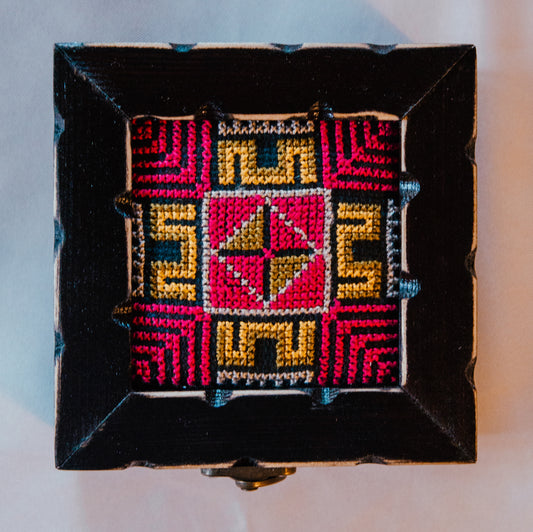
Tatreez Wooden Chest: Ramallah Disc of Feathers
Regular price $65.00 USDRegular priceUnit price per